Tack modification
This is a typical reason for selecting suitable grades. Check the manufacturer’s data sheet for the actual formulation and service conditions.
 Get in touch ↗
A resin used to help adhesive formulations stick, rather than a single structural plastic like nylon.
Polymer / material family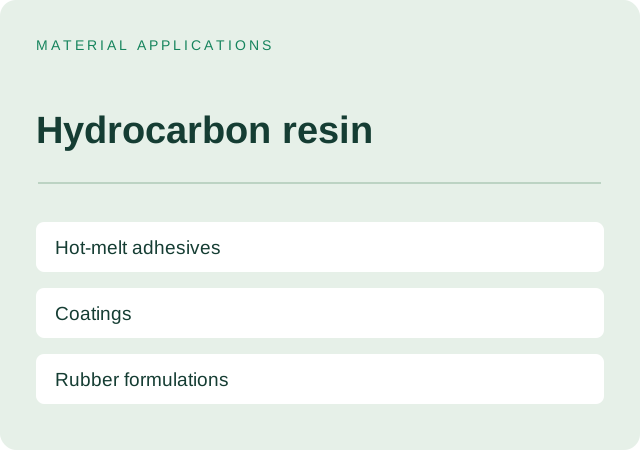
Hydrocarbon resin means Hydrocarbon tackifying resin.
A resin used to help adhesive formulations stick, rather than a single structural plastic like nylon.
Hydrocarbon resin covers several chemistries and grades. Share the trade name, safety data sheet and whether it is neat resin or a formulated adhesive.
This is a typical reason for selecting suitable grades. Check the manufacturer’s data sheet for the actual formulation and service conditions.
This is a typical reason for selecting suitable grades. Check the manufacturer’s data sheet for the actual formulation and service conditions.
This is a typical reason for selecting suitable grades. Check the manufacturer’s data sheet for the actual formulation and service conditions.
Properties vary with formulation, reinforcement, moisture, processing and service conditions. Use the exact grade data sheet for engineering decisions.
A known grade and a clean, separated batch make the recycling enquiry more useful. A route must still be agreed.
Hydrocarbon resin covers several chemistries and grades. Share the trade name, safety data sheet and whether it is neat resin or a formulated adhesive.
Poly-Cycle can discuss your material information and collection requirements. Inclusion in this guide does not confirm acceptance, a particular recycling method or that every operation takes place at a Poly-Cycle facility.
How assessment and collection workSend the team your grade details, approximate quantity and photographs. We can discuss the information needed for your particular batch.
A high-performance, often amber-coloured plastic used in precise components exposed to heat.
Understand this material PEEKA high-performance thermoplastic used when demanding mechanical, temperature and chemical conditions rule out many ordinary plastics.
Understand this material PPSUA tough, high-temperature sulfone polymer used for demanding technical parts.
Understand this materialGeneral material information reviewed 1 November 2026. Manufacturer information supports the material descriptions; recycling enquiry guidance is an editorial synthesis, not a statement of a supplier’s or Poly-Cycle’s acceptance criteria.
Browse this guide under: High Performance Plastics. The original category inventory was informed by RM Group’s plastics directory; explanations have been written for Poly-Cycle.